 .
What Are Aflatoxins?
Aflatoxins are a group of mycotoxins – toxic substances produced by certain moulds belonging to the genus Aspergillus. Their development is favoured by specific temperature and humidity conditions, and contamination can occur both before crops are harvested and during improper storage. Aflatoxins can be found in various agricultural crops and raw materials, including maize, cereals, nuts and other commodities. Of particular importance is aflatoxin B1 (AFB1), one of the most potent genotoxic and carcinogenic aflatoxins. AFB1 is directly associated with the occurrence of aflatoxin M1 in milk.
How Does Aflatoxin M1 Get into Milk?
When dairy animals consume feed contaminated with aflatoxin B1 (AFB1), part of it is metabolised in the animal's body and converted into aflatoxin M1 (AFM1). AFM1 can subsequently be excreted into the milk.
This means that contamination originating at feed level can enter the dairy food chain:
Contaminated feed → AFB1 intake by the animal → formation of AFM1 → presence of AFM1 in milk
For this reason, an effective prevention strategy should include both monitoring feed for aflatoxin B1 and testing raw milk for aflatoxin M1.
Why Is Aflatoxin M1 a Concern?
Aflatoxins are a significant food safety concern due to their toxic effects. The European Food Safety Authority (EFSA) considers aflatoxins to be genotoxic and carcinogenic and recommends that dietary exposure should be kept as low as reasonably achievable. Particular attention is given to milk because milk and dairy products are widely consumed, including by children and other vulnerable population groups. For this reason, the concentration of AFM1 in milk is subject to regulatory limits and official controls.
What Is the Maximum Permitted Level of Aflatoxin M1 in Milk?
Under current European legislation, maximum levels have been established for aflatoxin M1 in milk and certain products intended for infants and young children.
For raw milk, heat-treated milk and milk intended for the manufacture of milk-based products, the maximum permitted level is:
0.050 μg/kg = 50 ng/kg = 50 ppt
For infant formula, follow-on formula and formula for young children, the maximum level is:
0.025 μg/kg = 25 ng/kg = 25 ppt
These limits are established by Commission Regulation (EU) 2023/915 on maximum levels for certain contaminants in food.
For dairy processors, the 50 ppt limit for raw milk is particularly important when establishing an effective incoming milk control programme.
Why Is Incoming Raw Milk Control Important?
Testing milk at the point of reception makes it possible to identify batches with elevated AFM1 concentrations before they enter the production process. This is particularly important for dairy plants receiving milk daily from multiple farms, suppliers or geographical regions.
Regular incoming control can help to:
- identify non-compliant batches of raw milk at an early stage;
- prevent their mixing with other quantities of milk;
- reduce the risk of using non-compliant raw material in production;
- improve supplier monitoring and traceability;
- support rapid decision-making during raw milk reception.
How Is Milk Tested for Aflatoxin M1?
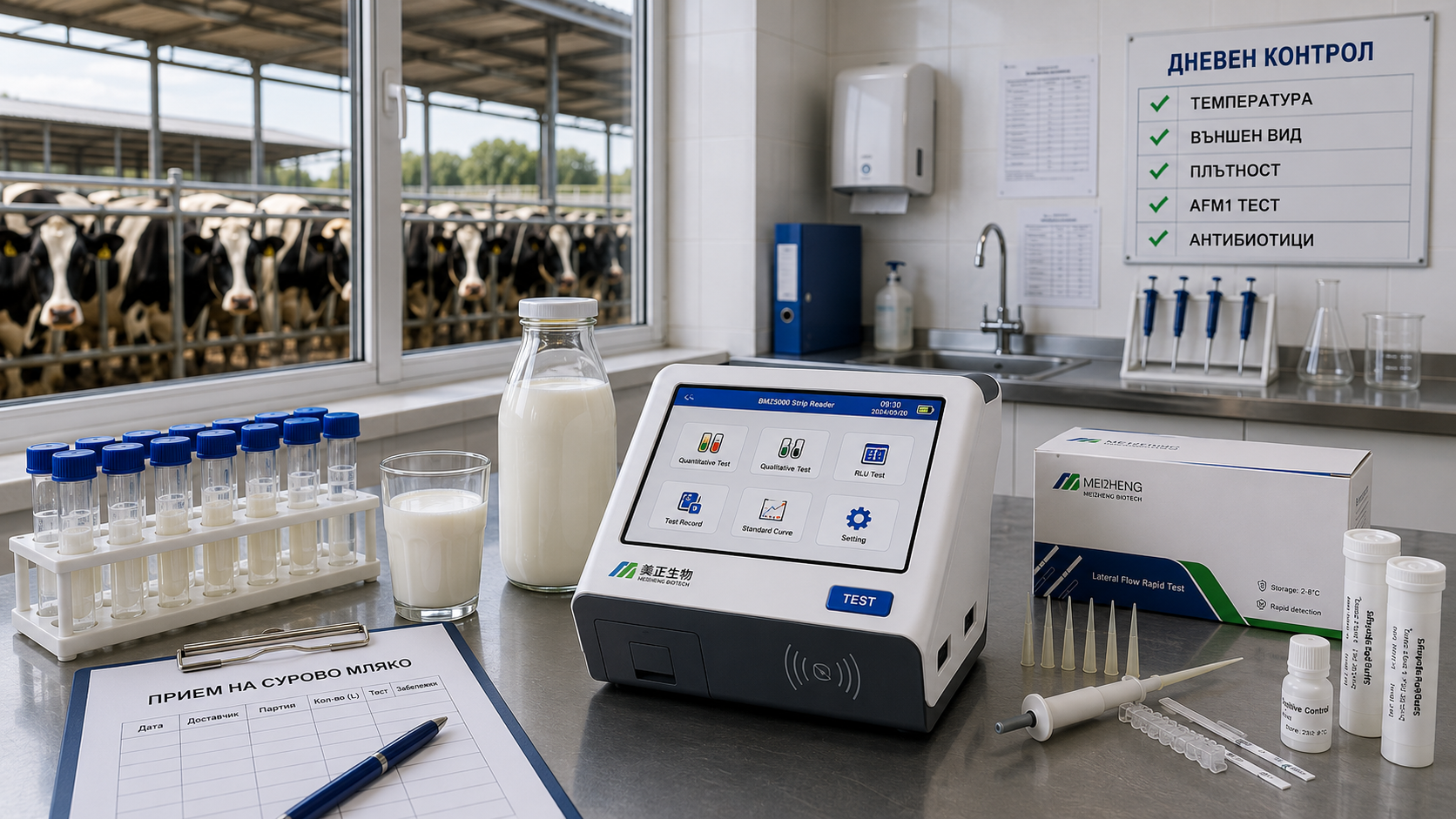
Different analytical methods can be used to determine aflatoxin M1 in milk, depending on the required accuracy, available equipment and purpose of the analysis. In addition to laboratory methods, rapid tests for aflatoxin M1 are increasingly used for routine incoming control. They enable testing to be performed directly at the dairy processing facility and provide results within a short period of time. Rapid AFM1 tests can be either qualitative or quantitative.
Qualitative Tests for Aflatoxin M1
A qualitative test provides a rapid assessment of a milk sample against a defined cut-off level. These tests are particularly suitable for routine screening during raw milk reception, when the primary objective is to quickly determine whether a sample meets the specified acceptance criterion.
Quantitative Tests for Aflatoxin M1
Quantitative tests determine the actual concentration of AFM1 in the sample. Results are obtained using a specialised reader and can be expressed, for example, in ppt or ng/kg. This approach provides more detailed information on AFM1 concentration and enables dairy processors to monitor results more precisely across different suppliers and batches of raw milk.
Rapid Tests for Aflatoxin M1 from Papazov-Nik Ltd.
Papazov-Nik Ltd. offers rapid tests for the detection and control of aflatoxin M1 (AFM1) in milk, suitable for incoming control in dairy processing plants and for in-house quality control laboratories. The cut-off levels of the tests we offer are aligned with the maximum levels (MRLs) for aflatoxin M1 established by European legislation.
Our product range includes:
Qualitative Rapid Test for Aflatoxin M1 with ILVO Validation
Designed for rapid screening of raw milk. The test enables easy assessment of a sample against a defined cut-off level and is an ILVO-validated solution for AFM1 control.
Quantitative Rapid Test for Aflatoxin M1
Determines the concentration of AFM1 in a milk sample using a specialised reader. It is suitable for dairy processors that require not only screening but also monitoring of measured AFM1 levels across different batches and suppliers.
5-in-1 Rapid Combo Test
A practical solution for the simultaneous qualitative detection of aflatoxin M1, melamine and antibiotic residues from the beta-lactam, tetracycline and sulfonamide groups in a single milk sample. Rapid tests provide results within a short period of time and enable efficient incoming control of raw milk.
Control Starts with the Raw Material
Monitoring aflatoxin M1 in milk is an important part of ensuring the safety of milk and dairy products. Combining AFB1 control in animal feed with regular AFM1 testing of raw milk helps identify potential risks as early as possible along the food chain. For dairy processors, rapid aflatoxin M1 tests provide a practical solution for daily incoming control and timely decision-making for each tested batch. Contact the Papazov-Nik team to select the most appropriate AFM1 test for your quality control programme. We provide support with method implementation, product demonstrations and training on the correct use of the tests.
Sources and Further Information
European Commission – Commission Regulation (EU) 2023/915 on maximum levels for certain contaminants in food. The Regulation establishes a maximum level of 0.050 μg/kg for aflatoxin M1 in raw milk, heat-treated milk and milk intended for the manufacture of milk-based products.
Регламент (ЕС) 2023/915 – EUR-Lex на български език
EFSA – European Food Safety Authority: Aflatoxins in food. Information on the origin of aflatoxins, the relationship between AFB1 in animal feed and AFM1 in milk, and the food safety risks associated with exposure to aflatoxins.
EFSA – Risk assessment of aflatoxins in food. Scientific assessment of the risks associated with aflatoxins in food, including aflatoxin M1 (AFM1) and exposure through milk and dairy products.
EFSA – Risk assessment of aflatoxins in food